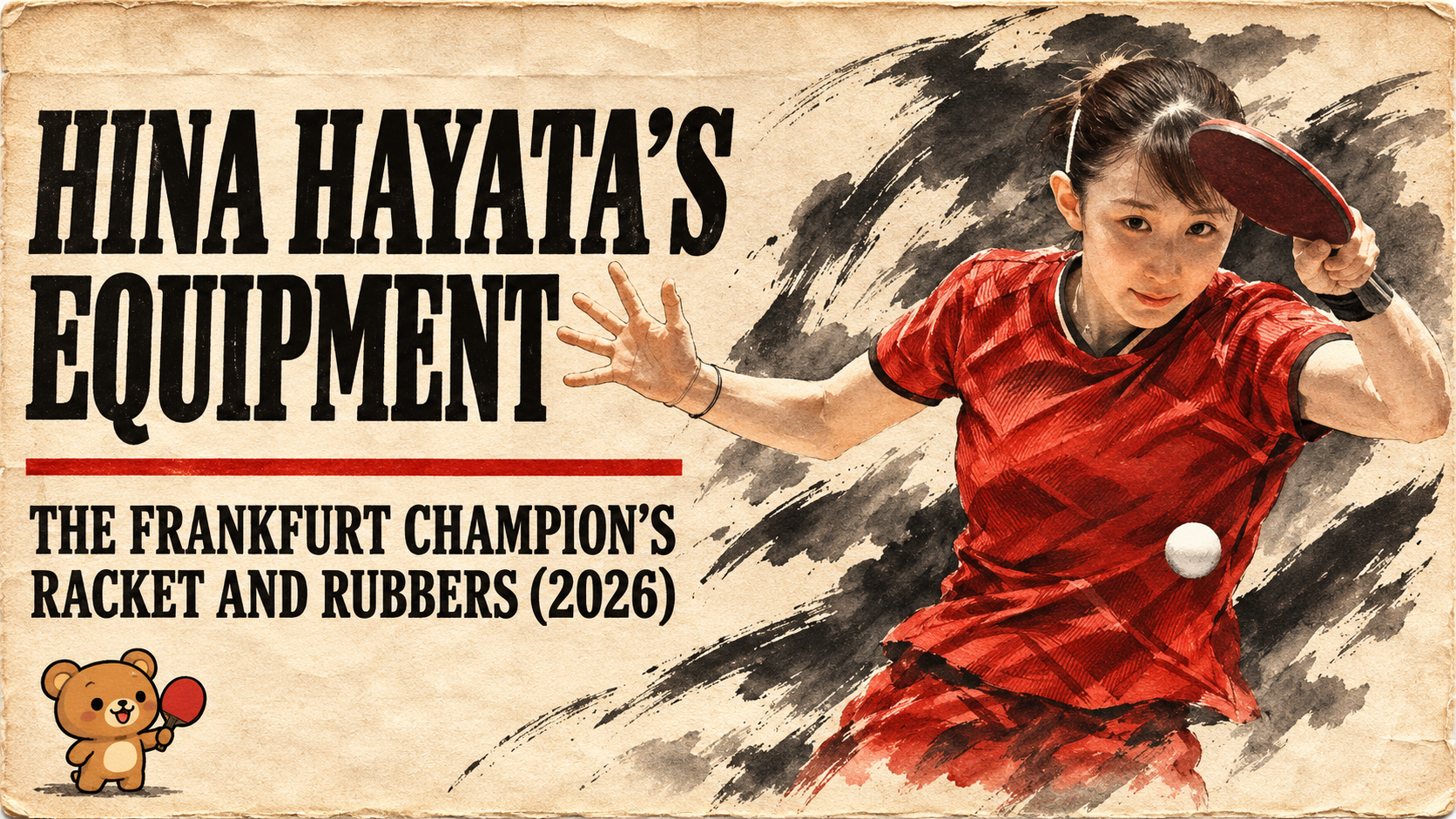
Hina Hayata won her second consecutive WTT Champions Frankfurt women’s singles title in November 2026, beating Satsuki Odo 4–2 in the final. If that result made you curious about her equipment, the setup I want to look at is the one reported at WTT Champions Montpellier: a Nittaku Hina Hayata H2 blade, Hurricane on the forehand, and Dignics 09C on the backhand.
I’m Takkuma. I’ve played table tennis for 18 years, competed at Japan’s national level, coached for 8 years, and run a club.
What I like about this pairing is that both rubbers have a tacky surface, meaning the surface has a slight stickiness.
You can build your game around spin on both sides and still give each side a different job.

Quick Answer
| Item | Hina Hayata’s equipment or playing style |
|---|---|
| Racket | Nittaku Hina Hayata H2 |
| Forehand rubber | Hurricane 3 National Blue Sponge, listed by Nittaku at the 2025 World Championships. Nittaku later described her forehand as custom-ordered Hurricane. |
| Backhand rubber | Butterfly Dignics 09C, reported at WTT Champions Montpellier by Table Tennis Lounge |
| Playing style | Left-handed attacker with a shakehand grip, which resembles a handshake |
Sources for the equipment listing include Nittaku’s player updates and the Montpellier report from Table Tennis Lounge on Instagram. www.nittaku.com
Who Is Hina Hayata?
Hayata was born on July 7, 2000, in Fukuoka Prefecture, Japan, and is 167 cm tall. At Paris 2024, she injured her left playing arm during the women’s singles quarterfinal. Shortly before the bronze-medal match, her arm was reportedly at about 20–30% of its usual condition. She won singles bronze and also earned silver in the women’s team event.
In January 2025, she beat Miwa Harimoto 4–0 to win her third consecutive All-Japan women’s singles title. At the 2026 Asian Games, she earned singles bronze after losing 1–4 to Sun Yingsha in the semifinal. She also reached the women’s doubles final with Harimoto.
The Racket — Nittaku Hina Hayata H2
Nittaku developed the H2 for Hayata, who tested it repeatedly during development. The blade is the solid part of the racket that the rubbers attach to. In the H2, the PKC layers, made from Kevlar and carbon, sit deeper inside the blade. Nittaku designed it to preserve a wood-like feel on gentle contact and deliver more power when you swing hard.
| Nittaku’s official specification | Hina Hayata H2 |
|---|---|
| Construction | 5 wood plies + 2 inner PKC layers |
| Blade thickness | 5.8 mm |
| Listed weight | 88 g (±) |
| Blade dimensions | 158 × 152 mm |
| Feel | Middle |
| Speed | Mid-Fast |
| Price | ¥33,000 including tax |
Specifications and price are from Nittaku’s official product page.
I’d think about the H2 in terms of the shots you play most often. For a short return over the table, the wood-like response is designed to give you feedback on a gentle touch. On a drive, an attacking stroke with topspin, that sense of the ball staying on the racket briefly can help you shape its flight. From mid-distance, when you’ve backed away from the table, the inner composite is there to support a stronger swing.
At ¥33,000 including tax, the H2 is a substantial purchase. I’d consider it if you already value a delicate touch close to the table and regularly swing hard when the rally opens up.
Forehand — Hurricane 3 National Blue Sponge
Nittaku listed Hurricane 3 National Blue Sponge on Hayata’s forehand at the 2025 World Championships. Its December 2025 update described the rubber as custom-ordered Hurricane. Table Tennis Lounge also identified National Blue Sponge at Montpellier. The exact specification of Hayata’s sheet remains private. www.nittaku.com
I see the appeal most clearly on the first forehand against backspin, the backward rotation that can pull your return down into the net. A full swing and a quick brushing contact help you lift the ball while giving it enough topspin to dip back onto the table. That’s the kind of stroke that makes a tacky forehand worth considering.
If you want to try that style, I’d start with retail NEO Hurricane 3 on your current blade. See how your serves, short returns, and first forehand drives change before deciding whether to replace anything else.
Backhand — Butterfly Dignics 09C
Table Tennis Lounge reported that Hayata used Butterfly Dignics 09C on her backhand at WTT Champions Montpellier. That’s the setup I’m examining here. Her backhand is reported, not officially published by Nittaku, and the Montpellier report covers that event. Table Tennis Lounge on Instagram. www.nittaku.com
Butterfly describes Dignics 09C as a tacky, high-tension rubber. What interests me about pairing it with Hurricane is the chance to attack with spin when the ball lands on either side of your body. On the forehand, you can use a fuller swing to generate spin. On the backhand, you can use a shorter motion and still brush the ball actively, especially when opening against a low return.
Who This Setup Suits
I’d consider this pairing if you take a full forehand swing, already feel comfortable with tacky rubber, and want to put spin on your first attack from either wing. It also makes sense if you can accelerate through a short backhand stroke when a return comes at you quickly.
If you like a softer feel or want easy depth with a light swing, I’d look for something more forgiving. I’d judge the fit by a shot that comes up in matches: when you arrive a little late against a low ball, can you still land your backhand opening deep enough to keep your opponent from attacking it easily?
Final Verdict
The setup I’d take away from Montpellier is Nittaku Hina Hayata H2, Hurricane on the forehand, and Dignics 09C on the backhand. Nittaku lists the H2 and custom Hurricane. The Dignics 09C backhand is reported, not officially published by Nittaku. For your own racket, I’d start by thinking about which ball you want to attack first on each side and how much room you have to swing.