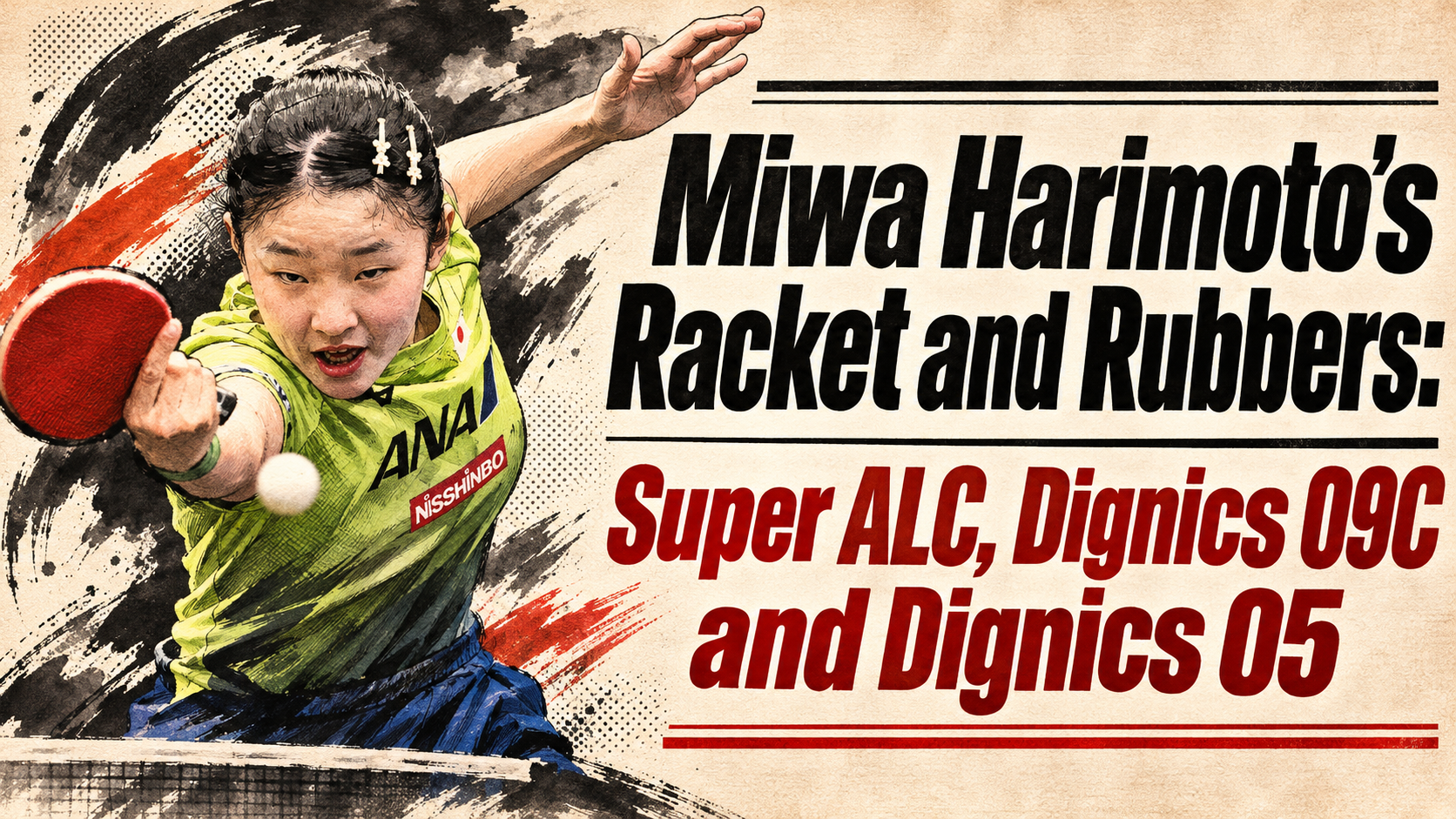
This article is based on Butterfly’s official player listing as of December 18, 2025. Butterfly listed Miwa Harimoto with the Harimoto Tomokazu Innerforce Super ALC blade, Dignics 09C on her forehand, and Dignics 05 on her backhand.
Miwa is a young, right-handed attacking player who was ranked world No. 3 as of November 2026. She uses a shakehand grip, which looks like shaking hands with the racket handle. She also reached the semifinals of WTT Champions Frankfurt in November 2026, where she lost to Hina Hayata.
I’m Takkuma, a table tennis equipment blogger in Japan. I’ve played for 18 years, competed at national tournaments, and coached for 8 years. I also run a table tennis club. The question I find most interesting about Miwa’s equipment is whether the different jobs she gives her forehand and backhand rubbers can help you choose your own.
Quick Answer: Miwa Harimoto’s Blade and Rubbers
As listed by Butterfly on December 18, 2025.
| Part | Equipment | Price in Japan |
|---|---|---|
| Blade | Butterfly Harimoto Tomokazu Innerforce Super ALC | ¥25,300 |
| Forehand rubber | Butterfly Dignics 09C | ¥10,450 |
| Backhand rubber | Butterfly Dignics 05 | ¥10,450 |
| Total | Blade and both rubbers | ¥46,200 |
Butterfly Japan official online shop prices, November 2026. Prices include Japanese consumption tax.
Why Do Some Sites List Different Rubbers?
You may see English-language equipment pages listing ZYRE 03 on both sides or Dignics 05 on both sides. Equipment can change over time or from one tournament to another, and pages may reflect different dates or use different sources. That makes the date especially important when you compare listings.
I use Butterfly’s dated player listing for the setup in this article. It gives us a specific combination to look at and a clear point of reference if you find a different setup elsewhere.
The Blade: Harimoto Tomokazu Innerforce Super ALC
The blade is the racket without its rubbers. This one carries the name of Miwa’s older brother, Tomokazu Harimoto. Butterfly introduces it as a model used by both siblings. I find that connection interesting because you can start with the same blade as another player and still shape the racket around the shots you play with each side.
| Official blade specification | Butterfly data |
|---|---|
| Construction | 5 wood plies + 2 Super Arylate-Carbon layers |
| Fiber placement | Innerfiber |
| Reaction property | 11.4 |
| Vibration property | 9.5 |
| Blade thickness | 5.9 mm |
| Blade head size | 158 × 152 mm |
| Average weight | 87 g |
| Country of manufacture | Japan |
Super ALC stands for Super Arylate-Carbon, the composite material used in the blade. In Butterfly’s Innerfiber construction, those layers sit closer to the core, with wood between the composite and the playing surface. In my view, the appeal is a combination of dwell and rebound. Dwell describes the feeling that the ball stays on the racket briefly during contact. Rebound is how readily the ball comes off the blade.
Butterfly’s reaction and vibration figures describe rebound and vibration in its own rating system. When I think about those figures alongside the inner construction, I can see why this blade makes sense for close-to-the-table play. A counter is an attacking reply to an incoming attacking ball. Close to the table, you have little time for a big swing, so a short stroke that uses the opponent’s pace can be especially valuable. On a softer exchange, a sense of dwell can help you judge the touch you need to place the ball.

Forehand: Butterfly Dignics 09C
Dignics 09C is Butterfly’s tacky High Tension rubber. Tacky means the outer surface has a lightly sticky feel, while High Tension is Butterfly’s term for a rubber designed with built-in tension. Its official ratings show a strong emphasis on spin and arc.
| Official rubber specification | Dignics 09C |
|---|---|
| Speed | 79 |
| Spin | 96 |
| Arc | 96 |
| Sponge hardness | 44 |
Arc describes how much the ball’s flight tends to curve. The sponge is the layer beneath the rubber’s outer surface. Dignics 09C combines a spin rating of 96 and an arc rating of 96 with a firm sponge rated 44.
For me, the clearest use for 09C is a forehand drive, an attacking stroke that sends the ball forward with topspin. Topspin is forward rotation that helps the ball dip toward the table. When I coach a player opening against backspin, which rotates in the opposite direction, I look for a stroke that brushes the ball and gives it enough height to clear the net. In my view, the grip and higher arc of 09C make that a natural shot to build around if you can make a confident stroke with a firm rubber.
Grip also matters over the table. A stop, also called a short push, is a soft return intended to keep the ball short. I’d use a light touch for that shot, then make a more active brushing contact if the next ball is long enough to attack. The same distinction applies to a chiquita, a backhand flick that uses a brushing motion to attack a short ball over the table. Grip can help produce spin on that shot, and in this setup the chiquita would normally be played with Dignics 05 on the backhand.
Backhand: Butterfly Dignics 05
Dignics 05 is a High Tension rubber with a higher published speed rating and a softer sponge than Dignics 09C. Its lower arc rating also suggests a relatively more direct flight. Here’s how the official figures compare.
| Butterfly rating | Dignics 05 | Dignics 09C |
|---|---|---|
| Speed | 86 | 79 |
| Spin | 85 | 96 |
| Arc | 88 | 96 |
| Sponge hardness | 40 | 44 |
In my view, the combination of 86 speed and 40 sponge hardness makes Dignics 05 an appealing backhand option for players who generate pace with short movements. A flick is a compact attack against a short ball, usually played before the ball drops below net height. When the ball comes back quickly after the flick, a compact backhand counter makes it easier to recover for the next shot.
A block uses a short motion and the opponent’s incoming pace to send the ball back. With a responsive rubber like 05, I’d pay close attention to the racket angle, especially against heavy topspin. When you get that angle right, you can take the ball early and send it back quickly with very little backswing.
Dignics 05 can still produce plenty of topspin, as its official spin rating of 85 suggests. What interests me about pairing it with 09C is that 05 gives the backhand a quicker, more direct option for flicks, counters, and repeated attacks.
Why This Split Works for Her Style
Miwa’s setup makes sense to me for a player who attacks close to the table and adjusts her touch to the incoming ball. The forehand side gives her a setup built around grip and arc, while the backhand side gives her a quicker response for compact strokes. You can see how those jobs fit together by imagining a typical exchange.
Suppose your opponent serves short to your backhand. You can flick with 05 and recover quickly enough to counter the next ball. If that reply comes long to your forehand, you can use 09C to play a heavier topspin drive. When your opponent keeps the ball short, you can adjust your touch and placement before looking for another chance to attack.
That’s the pairing in practical terms. The forehand gives you spin and a sense of dwell for shaping the ball. The backhand gives you speed for keeping pressure on through successive shots. As a coach, I’d look at how often you play those shots in matches before deciding whether the combination fits you.
How Much Does Miwa Harimoto’s Setup Cost?
| Item | Price including tax |
|---|---|
| Harimoto Tomokazu Innerforce Super ALC | ¥25,300 |
| Dignics 09C | ¥10,450 |
| Dignics 05 | ¥10,450 |
| Total | ¥46,200 |
Butterfly Japan official online shop prices, November 2026.
Dignics 09C and Dignics 05 are open-price products in Japan. That means retailers can set their own selling prices. The rubber prices above are what Butterfly Japan listed in its online shop for the stated month. Your total can vary by country and retailer.
Should You Copy Her Setup? My Verdict
I’d consider this combination if you’re an intermediate or advanced close-to-the-table attacker who already has a reliable forehand drive and likes following a backhand opening with another quick attack. It makes particular sense if you want more grip and arc on the forehand and a faster response from the backhand.
I’d start elsewhere if you’re a beginner, you’re trying to keep costs down, or you prefer a soft feel on both sides. Dignics 09C has a firm sponge, and on the backhand, Dignics 05 asks for good control of racket angle and timing. If you’re still learning to brush the ball or manage incoming topspin, I’d choose a setup that feels comfortable during ordinary practice rallies.
My advice is to try one side at a time. Keep your current blade and backhand rubber if you want to find out what 09C does for your forehand. Try it on short pushes, opening drives against backspin, and drives during a rally. Pay attention to whether you can produce the spin and depth you want with your usual swing.
If your backhand is the side you want to change, start with 05. Test your short-ball flick, your block against a strong drive, and your ability to play another backhand immediately afterward. I’d put more weight on that follow-up shot than on how fast your best single shot feels.

Summary
Butterfly’s official player listing as of December 18, 2025 shows Miwa Harimoto using the Harimoto Tomokazu Innerforce Super ALC with Dignics 09C on the forehand and Dignics 05 on the backhand.
The complete setup comes to ¥46,200 at Butterfly Japan’s November 2026 online shop prices. What I’d take from her setup is the idea of choosing each rubber for a specific job.
Start with the side where a change would help the shots you play most often.